
Loading...
Serving Big Spring, TX and surrounding areas. (432) 263-5110
A damaged or failing concrete floor is not worth patching forever. We break it up, haul the rubble, and leave you a clean surface ready for whatever comes next.
Concrete floor stripping and removal in Big Spring means breaking up an existing concrete slab or floor coating and hauling the debris away so the space is ready for whatever comes next. Most single-room or garage removals take one to two days from start to cleanup, depending on the thickness of the slab and how accessible the space is for equipment.
If your floor has shifted, cracked repeatedly, or reached the point where patching is no longer a realistic fix, removal and a fresh start is often the more cost-effective long-term answer. We serve homeowners and property owners throughout the Big Spring area. Once the old concrete is out, our Epoxy Floor Coatings and Concrete Grinding and Surface Preparation services are ready to get your new surface finished and protected.
If you have had cracks patched before and they have returned - or if new cracks appear in the same general area - the slab itself may have shifted too much to repair. In Big Spring, this is especially common because the clay soil expands and contracts with the seasons, and a slab that has moved significantly cannot be stabilized with surface patching alone. Removal and a fresh pour is often the more cost-effective long-term answer.
Walk slowly across your concrete floor and listen for a dull, hollow sound when you tap it with your heel. That hollow sound means the concrete has separated from the soil underneath - a condition called delamination - and those sections are at risk of cracking or collapsing under load. This is a sign the slab has lost its structural integrity and needs to come out.
If you are updating a garage, basement, or utility room and existing paint, epoxy, or tile adhesive is peeling, bubbling, or bonded so tightly that grinding alone will not clean it up, full removal may be the cleaner path. Trying to apply a new coating over a compromised surface almost always leads to the new finish failing within a year or two.
Big Spring's clay soil is particularly active after heavy rains, and garage slabs - often thinner and less reinforced than home foundations - are vulnerable to heaving. If one section of your floor sits higher or lower than the rest, or if a door no longer closes properly because the floor has shifted, the slab has moved beyond what patching can fix.
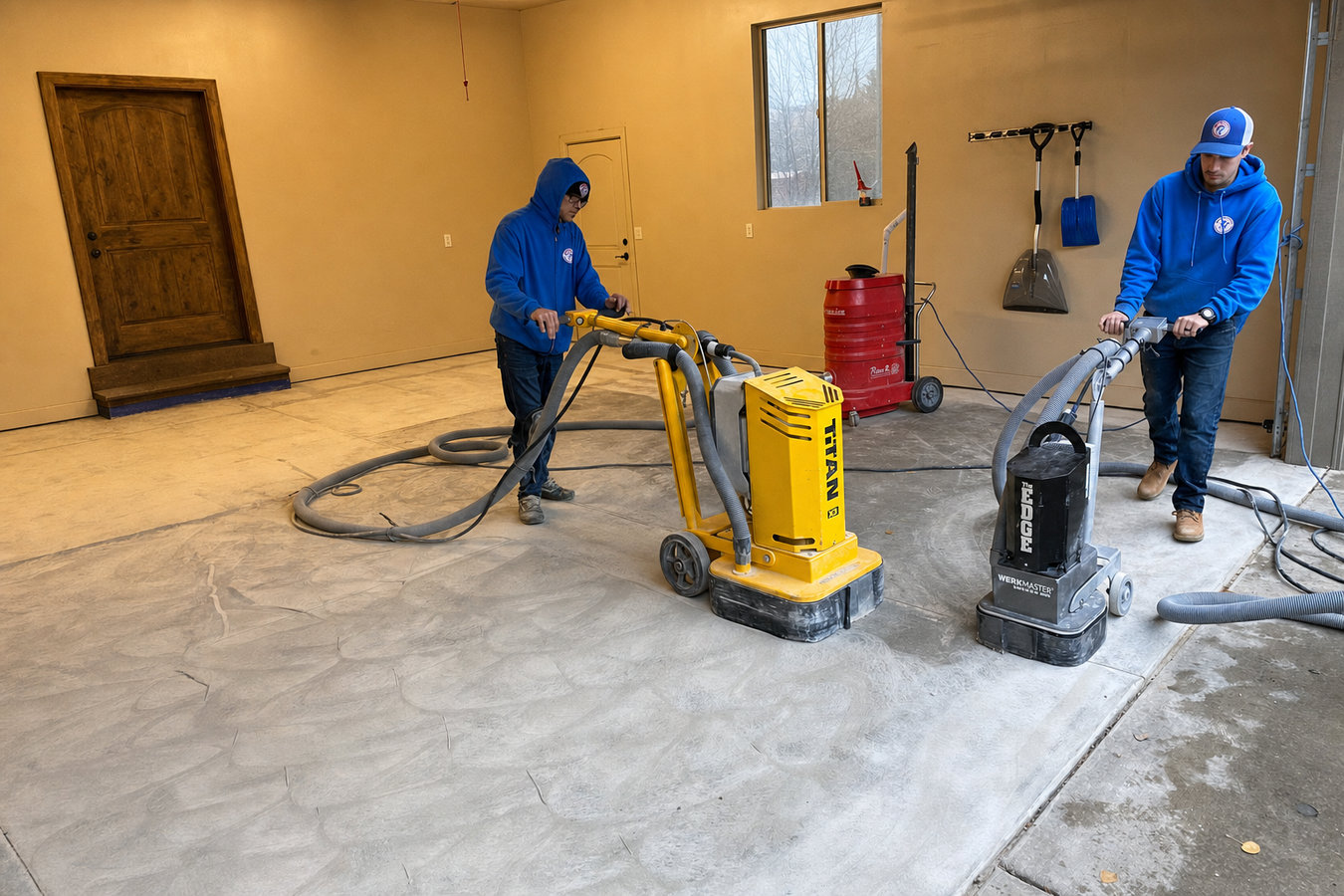
We handle concrete floor removal for residential garages, basements, utility rooms, and outbuildings throughout the Big Spring area. The right tools for a removal job depend on how thick the slab is and how accessible the space is - we assess that during the estimate visit and come prepared with the right equipment, whether that is a jackhammer, a walk-behind breaker, or floor grinding machines for coating stripping. All debris hauling is included in our quotes - we load the rubble and take it to a recycling facility so you are not left with a pile in your driveway.
We also walk you through the subbase condition once the concrete is out, because what is underneath your old slab affects what needs to happen before new concrete is poured. If the soil has moved significantly - something common in Howard County given the clay-heavy ground - we will tell you exactly what preparation is needed before the next pour. Once the space is clean and ready, our Epoxy Floor Coatings team can finish the new surface, or our Concrete Grinding and Surface Preparation service can get the fresh slab ready for any coating or finish you choose.
Best for garage floors, basement slabs, and interior rooms where the concrete has failed, heaved, or can no longer be repaired.
Best for surfaces where old paint, epoxy, or adhesive has failed and needs to be fully removed before a new finish can be applied.
Best when only specific sections of a floor have shifted, heaved, or delaminated and the rest of the slab is still sound.
Best for homeowners who want a complete job - concrete broken up, rubble removed, and work area cleaned before we leave.
Much of Howard County sits on shrink-swell clay soil - ground that expands when it gets wet and contracts when it dries out. This constant movement is one of the main reasons concrete slabs crack and shift in this area, and it is why removing an old, compromised slab and starting fresh with a properly prepared subbase is so often the right call. When we remove your old concrete, we assess whether the soil underneath has moved significantly, because pouring new concrete over unstable ground without addressing it first will lead to the same problems repeating. Big Spring also has a significant number of older homes - many built in the 1950s through 1970s - and those slabs were often poured thicker and with different mix ratios than modern concrete, which means they can take longer to break up. We factor that in from the start when we give you an estimate.
Big Spring's dry, windy climate also means concrete dust from removal work can travel quickly during outdoor-adjacent jobs or in spaces connected to living areas. We use proper dust containment on every job. We serve property owners throughout the region, including customers in Midland and Odessa, where similar soil and climate conditions apply.
Tell us about the space - roughly how large it is, what the floor looks like, and what you are planning to do after removal. We will reply within one business day to schedule a site visit. No contractor can give you an accurate price without seeing the slab in person.
During the visit, we look at slab thickness, check for structural issues, assess how accessible the space is for our equipment, and ask what comes after removal - because that affects how clean and level we need to leave the surface. You get a written quote that covers labor, equipment, and debris hauling before we ask you to commit.
Clear everything out of the work area - furniture, appliances, stored boxes, and vehicles if it is a garage. Cover HVAC vents with plastic and tape to keep concrete dust out of your system. In Big Spring's dry, windy climate, the more thoroughly you seal the work area from the rest of your home, the better.
We break up the concrete, load the rubble, and clean up the area as we go. Before we leave, we walk the space with you, show you the subbase condition, and flag anything that needs attention before new concrete is poured. That conversation is important - do not skip it.
We will come out, look at your slab, and give you a straight answer - no sales pitch, no pressure. If patching makes more sense, we will tell you that too.
(432) 263-5110Some contractors price debris removal separately and spring it on you at the end of the job. We include hauling in every written estimate so you know the full cost before we start. The rubble goes to a recycling facility where it gets processed as road base - nothing gets left in your yard.
When the old concrete comes out, you finally see what has been happening underneath - whether the soil has shifted, whether there is a moisture issue, whether the old slab was ever properly supported. We walk you through it and tell you what needs to happen before new concrete goes down. In Big Spring, where clay soil movement is a fact of life, that assessment is worth more than any surface-level patch job.
Concrete dust contains fine particles that warrant proper control, as noted by OSHA silica standards for construction work. We use vacuum-equipped equipment, wet cutting where appropriate, and seal off doorways with plastic sheeting. In Big Spring's dry, windy conditions, that containment matters - especially when the work is near your home's air system.
Many homes in Big Spring were built in the 1950s through 1970s with thicker, harder slabs than what is poured today. That affects the timeline and the equipment needed. We ask about your home's age during the estimate and factor it into the quote from the start, so there are no surprises when the crew arrives and finds a slab that is harder to break up than a modern one.
Getting concrete removed is not glamorous work, but it matters when it is done right. We focus on leaving you a clean, accurate subbase assessment and a complete written record of the job so the next step - whether that is a new pour, an epoxy floor, or something else - starts from a solid foundation.
Once your old concrete is out and your new slab is cured, epoxy floor coatings give it a durable, cleanable, professional finish that holds up to daily use.
Learn MoreFor surfaces that do not need full removal but need old coating stripped, high spots ground down, or a proper profile created before a new finish is applied.
Learn MoreSpring and fall slots fill up fast in West Texas - lock in your date before the summer heat makes scheduling harder for everyone.